Executive Summary
As data centers evolve to support hyperscale computing, edge deployments and real-time digital services, the demand for highly resilient and efficient power systems continues to grow. Traditional centralized AC-UPS architecture remains critical, but complementary 24 VDC power systems are increasingly deployed to protect control circuits, networking equipment and auxiliary systems. Technologies such as DC-UPS controllers, supercapacitor modules and buffer modules provide protection against power disturbances. When selecting the right technology for the application, 24 VDC backup systems enhance uptime, improve system responsiveness and reduce maintenance requirements. This edition of The PULS Current explores how DC backup technologies support data center control power systems and how to achieve this alignment between technology and application.
Introduction
Modern data centers must deliver continuous, uninterrupted service despite growing exposure to grid instability, micro-outages and fluctuating demands from highly dynamic AI load profiles. Even momentary voltage dips can disrupt sensitive control systems, impacting network performance or automation processes. While large-scale battery-based UPS systems provide extended backup, they are not always optimized for short-duration disturbances or distributed applications.
As a result, operators are increasingly implementing targeted 24 VDC backup strategies within racks, control cabinets and edge nodes. These systems focus on high-speed response, compact design and minimal maintenance. DC-UPS controllers, supercapacitor modules and buffer modules form the backbone of this approach, delivering targeted protection for critical subsystems.
Overview of 24 VDC Power Architectures in Data Centers
In data centers, 24 VDC power architectures are commonly used to support industrial control systems, monitoring devices and communication infrastructure. Unlike traditional AC-based power distribution, DC backup systems minimize conversion losses and simplify integration at the device level.
A typical architecture includes a primary AC-DC power supply feeding a regulated 24 VDC bus. From this bus, critical loads such as PLCs, sensors and switches are powered. 24 VDC based backup and stabilization components—DC-UPS controllers, supercapacitors and buffer modules—can be integrated inline to maintain voltage continuity.
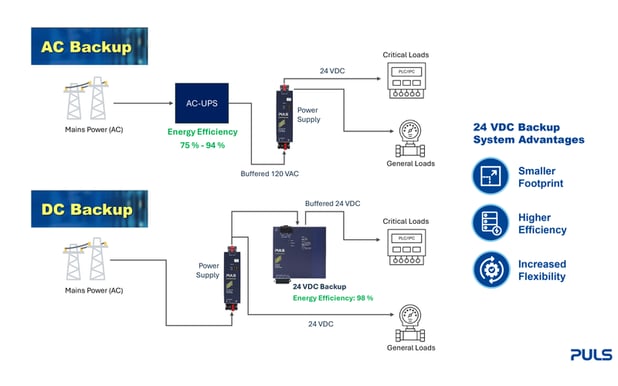
The key advantages of 24 VDC systems include improved efficiency due to fewer conversion stages, reduced system footprint and greater flexibility in modular design. These benefits make them especially attractive in edge data centers where space and responsiveness are critical. Within the 24 VDC system, you can also choose to only backup critical loads that must stay online for an extended period during an outage. This allows you to prolong the backup time provided to these important loads.
Key Technologies
DC-UPS with Batteries
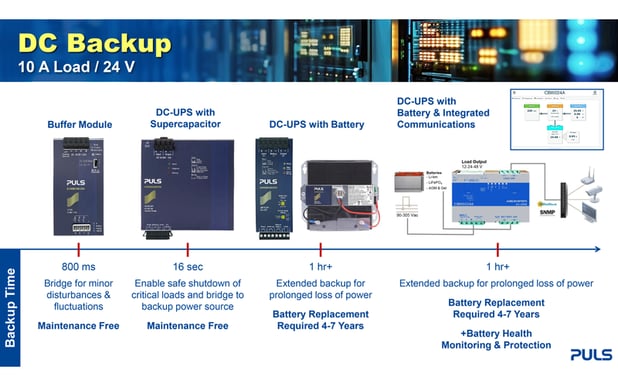
DC-UPS controllers act as the intelligence layer of a backup power system. They monitor input voltage, manage energy storage devices and automatically switch to backup power when a disturbance is detected.
In data center environments, DC-UPS controllers like the PULS UB20.241 enable seamless transitions during outages, preventing interruptions to sensitive equipment. Their built-in diagnostics and communication capabilities also provide visibility into system performance, supporting predictive maintenance strategies.
DC-UPS with Supercapacitors
Supercapacitors, or supercaps, are energy storage devices designed for rapid charge and discharge cycles. Unlike batteries, they store energy electrostatically rather than chemically, allowing them to deliver high power output almost instantly
In data centers, supercapacitor DC-UPS modules such as the PULS UC10.242 are ideal for bridging short power interruptions, typically ranging from milliseconds to several seconds. They excel in applications requiring high reliability and frequent cycling, such as protecting network switches or control systems. They are commonly used in data center applications where there may be a lag (15-20 seconds) between primary power loss and start-up of the backup generator power source.
Supercaps offer significant advantages over traditional batteries, including longer lifespans, maintenance-free operation and consistent performance across a wide temperature range. These characteristics make them particularly valuable in distributed or hard-to-access environments.
Buffer Modules
Buffer modules provide immediate voltage stabilization within a 24 VDC system. Their primary role is to absorb short-term power fluctuations, ensuring that the output voltage remains stable even during transient dips or sudden load changes.
Unlike supercapacitors, which are designed for brief energy storage, buffer modules like the PULS UF20.241 focus on smoothing and stabilizing power delivery. They are especially useful in preventing nuisance shutdowns and maintaining operational continuity for sensitive electronics.
In data centers, buffer modules are commonly deployed alongside power supplies and DC-UPS systems to provide an additional layer of protection against micro-disturbances.
Technology Selection in Data Center Applications
In today’s rapidly scaling data center environments, technology trends are also accelerating at fast pace. DC-UPS controllers with batteries have been prevalent given their proven ability to provide extended periods of backup power. However, as the industry and its designs are quickly maturing, there has been a shift towards more supercapacitor-based DC-UPS solutions. As mentioned above, these solutions are maintenance free and are therefore a great fit for facilities that are looking to mitigate as much downtime and maintenance as possible. That said, new battery technologies such as Lithium ion-based chemistries provide promising lifetimes in the 7 to 10 year range, which would align with facility design lifetimes. While some data center operators may still shy away from solutions that could require occasional maintenance checks, it is worth noting that many of today’s DC-UPS controllers come with communication capabilities (such as the Adelsystem CBI DC-UPS, family with integrated ethernet) that enable remote monitoring and minimize potential operator rounds.
Conclusion
As data centers become more automated and distributed, ensuring stable control power is increasingly critical. While centralized AC-UPS systems remain essential for bulk power continuity, they do not address short-duration disturbances that can disrupt sensitive control systems.
24 VDC backup architectures therefore move from optional add-ons to a core design element. The emerging best practice is a holistic, system-based approach (similar to the approach to redundancy outlined in a prior edition of The PULS Current), strategically leveraging each of the buffer module, supercapacitor and battery-based DC-UPS solutions available based on the time scale of power events, criticality of loads powered by 24 VDC power supplies and the extent of immediate backup power provided in upstream and downstream equipment (if any).
Ultimately, resilience is no longer defined by backup duration alone, but by the ability to prevent even minor power disturbances from impacting system operation. This shift places application-specific DC backup strategies at the center of next-generation data center power design.

We join the PULS Group

Our lines