
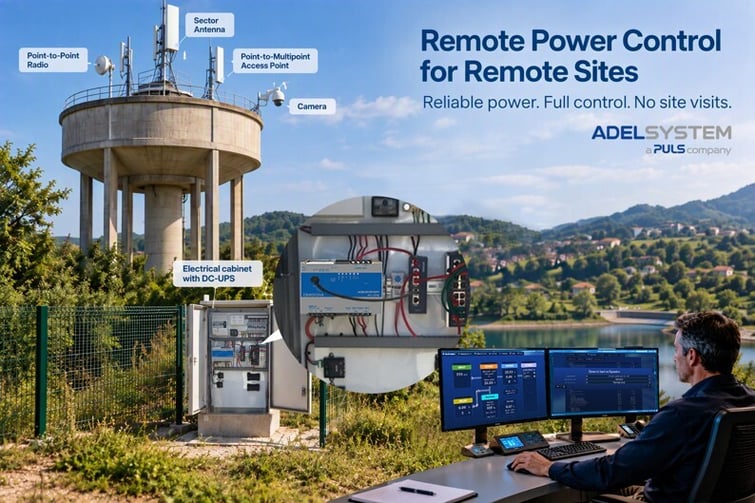
How to restart radios and routers remotely with the
DC-UPS with Ethernet: power cycle and watchdog for ISP and WISP networks
The DC-UPS with Ethernet, such as the CBI60W and CBI600W series from Adelsystem, can switch the output that powers radios, routers and switches off and on from a remote location. With the watchdog function, the DC-UPS pings a configured IP address and, if no reply arrives, runs a controlled power cycle by itself. This reduces site visits for simple restarts.
Key takeaways
- The DC-UPS is not only a backup: through its Ethernet interface the LOAD output becomes a remotely managed element of the network.
- A remote power cycle can replace an external IP relay and keeps power management inside the device already used for backup.
- The watchdog automates recovery: it detects a non-responding target and restarts the load without waiting for the NOC to open an incident.
- On towers and rooftops, remote LOAD OFF/ON supports maintenance and avoids an extra climb only to re-energize the equipment.
What is the DC-UPS with Ethernet and a controllable LOAD output?
A DC-UPS is a DIN rail module that combines an industrial power supply, a battery charger and battery monitoring, and keeps the connected equipment powered by the battery when the mains fails. In an Ethernet DC-UPS the interface also allows remote access to its functions, including switching the LOAD output on and off.
In the Adelsystem range, the CBI60W and CBI600W series have built-in Ethernet with an internal web server, Modbus TCP/IP, SNMPv3 and HTTPS. The models are CBI6012A (12 V 5 A), CBI6024A (24 V 2.5 A), CBI6048A (48 V 1.25 A), CBI60024A (24 V 25 A) and CBI60048A (48 V 12.5 A).
|
Term |
Meaning |
|---|---|
|
ISP / WISP |
Internet service provider / wireless internet service provider: networks made of distributed sites such as towers, rooftops and cabinets. |
|
NOC |
Network operations center: the control center that supervises the network. |
|
LOAD output |
The DC output of the DC-UPS that powers the connected equipment (radio, router, switch, gateway). |
|
Power cycle |
Switching the LOAD output off for a set time and then on again, so that the equipment fully restarts. |
|
Watchdog |
A function that periodically checks the reachability of an IP target and, if the expected replies are missing, runs a controlled power cycle. |
How to restart a frozen radio, router or switch remotely
When network equipment is still powered but no longer responds, the LOAD output can be switched off and restored without going to the site. The DC-UPS therefore replaces an external IP relay.
- Fault confirmation: the NOC verifies that the radio, router, switch or gateway is not responding.
- Load OFF: the DC-UPS removes power from the connected equipment.
- Power-off interval: the output stays off long enough to allow a complete shutdown.
- Load ON: the output is restored and the equipment restarts.
- Service verification: connectivity and the relevant network services are checked again.
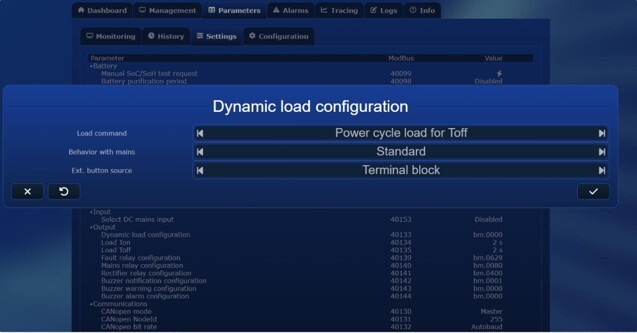
How the watchdog works: automatic recovery without NOC intervention
The watchdog extends the remote power cycle by automating fault detection.
The DC-UPS periodically checks the reachability of a configured IP target.
If the expected replies are not received according to the configured logic, it executes a controlled power cycle of the LOAD output.
- Periodic check: the DC-UPS sends a ping to the selected network target.
- Failure validation: missing replies are evaluated using the configured retry and timeout criteria.
- Automatic power cycle: the load output is disabled for the programmed off-time and then reactivated.
- Recovery check: after restart, the watchdog resumes supervision of the target.
Why use watchdog supervision
- Recovers locked equipment even when the NOC has not yet opened an incident.
- Reduces dependence on manual remote commands.
- Makes recovery repeatable through predefined logic.
- Supports unmanned sites where local access is slow or costly.
Maintenance on radio towers, rooftops and unmanned sites
On radio towers, rooftops and other elevated installations, the remotely controlled LOAD output supports maintenance: the connected equipment stays de-energized during the intervention and power is restored only after personnel have left the elevated or restricted area.
- Remote LOAD OFF: the NOC disables the load output before work begins, removing power from radios, switches, routers or transmission equipment.
- Maintenance activity: the technician completes replacement, cabling, inspection or commissioning while the equipment is de-energized.
- Personnel leave the elevated area: after the activity, personnel descend from the tower or leave the rooftop or restricted area.
- Remote LOAD ON: the NOC restores the load output without requiring anyone to climb the tower again only to re-energize the equipment.
- Remote verification: start-up, connectivity and relevant network services are verified from the control center.
Operational advantages
- No additional climb is required to restore power after maintenance.
- Reduced exposure of personnel to work-at-height activities.
- Controlled re-energization only after the area has been cleared.
- Faster post-maintenance start-up and functional verification.
- Greater efficiency when servicing unmanned or difficult-to-access sites.
Operational value
- Fewer site visits for simple restart operations.
- Shorter recovery path from fault detection to equipment reboot.
- Centralized power and load management from the network operations environment.
- Safer maintenance workflow when equipment is installed at height or in restricted locations.
- One integrated device for power supply, battery management, backup and LOAD control.
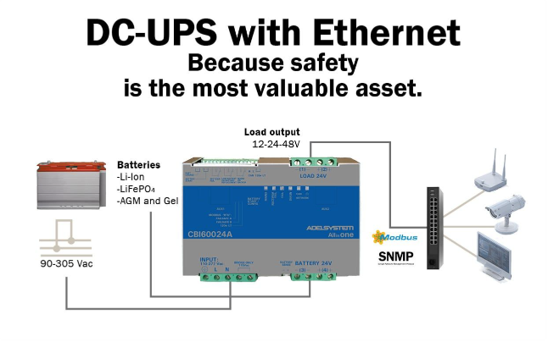
Monitoring and integration
The internal web server, Modbus TCP/IP, SNMPv3 and HTTPS interfaces give access to the DC-UPS parameters, so the unit can be integrated in SCADA platforms or IoT solutions. The operator can monitor AC input voltage; DC output voltage, current, power and status; battery voltage, current and internal resistance, and receive alarms on network, device and battery faults.
Frequently asked questions
What is a watchdog on a DC-UPS?
It is a function that periodically pings a configured IP target and, if the expected replies are not received according to the configured retry and timeout logic, runs a controlled power cycle of the LOAD output.
Can a DC-UPS replace an external IP relay?
Yes. When the LOAD output of an Ethernet DC-UPS is controlled remotely, power management stays inside the same device used for backup, so an external IP relay is not needed.
How do I avoid a restart caused by a single lost packet?
Use retry and timeout logic: the power cycle starts only if the missing replies meet the configured criteria, not after one transient packet loss.
Why is a restart policy needed?
A restart policy prevents repeated cycles from masking a persistent network or hardware fault.
Does remote LOAD control replace lockout and isolation procedures?
No. Isolation, lockout and verification procedures required by the installation and by the applicable safety rules remain independent of the DC-UPS control function.
Which interfaces does the CBI60W series offer?
An internal web server, Modbus TCP/IP, SNMPv3 and HTTPS, for monitoring through SCADA platforms or IoT solutions.
Which equipment can be powered and restarted?
Radios, routers, switches, gateways and transmission equipment connected to the LOAD output, within the voltage and current of the chosen model.
Conclusion
For ISP and WISP sites, the difference is not the network topology but how the powered equipment is managed. An Ethernet DC-UPS adds three practical functions to power continuity: remote power cycling, automatic watchdog recovery and controlled LOAD management during maintenance at elevated or hard-to-reach sites. This makes the DC-UPS an active element of service restoration.